
Reviewed · WALKING TOURS
Beautiful Stockholm Small Group Walking Tour
Stockholm rewards a good first walk. This 1-hour-45-minute tour links royal squares, government buildings, bridges, and Gamla stan in a compact route that gives you a useful sense of the city. I especially like the small maximum of 10 people, which should make it easier to hear the guide and ask questions. I also like the mix of famous sights and lesser-known political stories, from Sweden’s old four-estate parliament to the country’s long period of peace.
The main drawback is that the price, $106.42 per person, is high for a walking tour with no admission tickets included. You are paying for the guide’s storytelling, organization, and small-group setting rather than entry into the Royal Palace, Nobel Prize Museum, or other interiors. The route also calls for moderate physical fitness, so comfortable shoes are important.
In This Review
- Key Points Before You Book
- Starting at Gustav Adolf’s Square and the Royal Opera
- Reading Sweden’s Political Story at Riksdagshuset
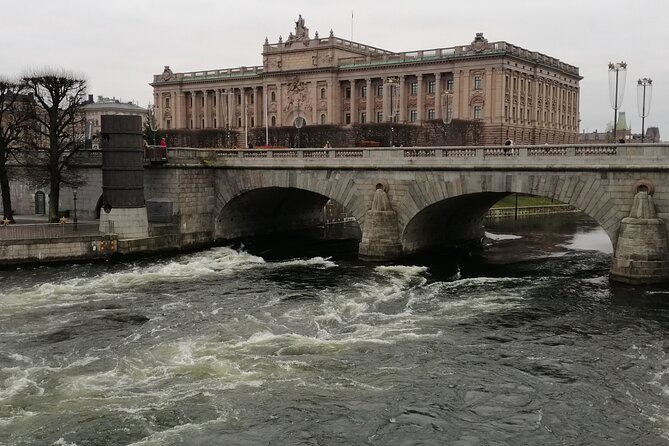
- Views from Riksbron Bridge
- Lejonbacken and the Royal Palace’s Northern Face
- Slottsbacken, the Palace Chapel, and the Bernadotte Dynasty
- Stortorget and the Darkest Chapter in the Old Town
- Köpmangatan and the Medieval Streets of Gamla Stan
- The Finish Near Kungsträdgården and Djurgården
- What $106.42 Buys You
- Who Will Get the Most From This Walk
- Practical Details for a Smooth Morning or Afternoon
- Should You Book the Stockholm Small Group Walking Tour?
- FAQ
- How long is the Stockholm walking tour?
- Where does the tour begin?
- Where does the tour end?
- Is the tour offered in English?
- How many people can join the tour?
- Can I cancel for a full refund?
Key Points Before You Book
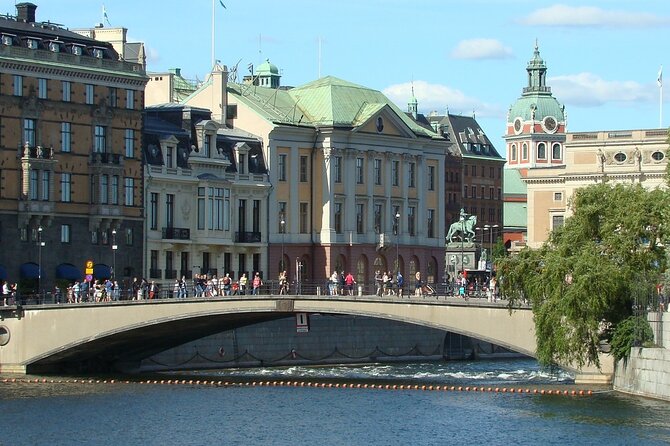
- A compact royal route: You pass the Royal Swedish Opera, Royal Palace, Palace Chapel, Grand Hotel, and several royal statues.
- A real Old Town walk: The route includes Stortorget, Köpmangatan, Österlånggatan, narrow medieval lanes, and the waterfront at Skeppsbron.
- Politics are part of the story: The Parliament Building and Riksbron bring Sweden’s government, monarchy, and constitutional changes into view.
- A tiny group: The tour accepts no more than 10 people, a useful advantage on narrow streets and busy squares.
- English and mobile ticket: The tour is offered in English, and confirmation arrives when you book.
- A convenient finish: The walk ends near Kungsträdgården, with a tram connection toward Djurgården’s museums.
Starting at Gustav Adolf’s Square and the Royal Opera
The meeting point is Gustav Adolfs torg, a central square near the Royal Swedish Opera. This is a sensible place to begin because the first few sights introduce the parts of Stockholm that shape the rest of the walk: monarchy, music, government, architecture, and the city’s position between water and old neighborhoods.
The opening introduction covers Sweden as the Kingdom of Sweden and places Stockholm within its royal setting. The Royal Palace comes into view in its grand Baroque form, built at the start of the 18th century. Even from outside, it gives you an immediate sense of how closely Swedish public life has long been tied to the crown.
The Royal Opera adds a cultural note. Its connection to Giuseppe Verdi’s opera The Masked Ball recalls the story of King Gustav III, whose life and death helped inspire the work. Across the square, the building now used by the Ministry of Foreign Affairs was once the palace of the heir presumptive. These details are useful because they turn a formal square into a place of competing roles: performance, diplomacy, monarchy, and administration.
You do not pay an admission fee at this stop. That does not mean the opening is filler. It gives you a quick visual map of central Stockholm before the route moves toward the parliament and Old Town.
More Walking Tours in Stockholm
- Stockholm: Ghost Walk and Historical Tour
★ 4.7 · 2,685 reviews - Stockholm Gamla Stan: Old Town Walking Tour with Local Guide
★ 4.7 · 1,714 reviews - Walking Tour of Stockholm Old Town
★ 5.0 · 1,175 reviews
Reading Sweden’s Political Story at Riksdagshuset
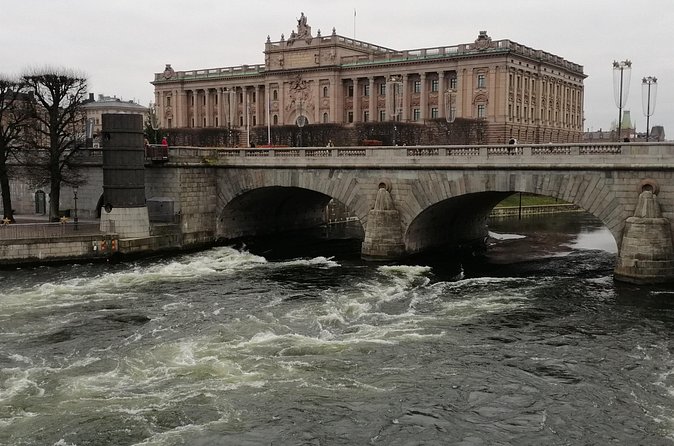
The Parliament Building, called Riksdagshuset, brings the country’s political past into the walk. Its Neo-Renaissance design, with a Neo-Baroque section on the facade, reflects the confidence of the late 19th century. Construction took place from 1897 to 1905.
The building matters even more for what it represents. Before modern parliament, Sweden had the Riksdag of the Estates. Nobility, clergy, burghers, and peasants met separately, then came together to meet the king. This arrangement lasted until 1866, when a two-chamber parliament replaced it.
The change did not instantly create equal political participation. Sweden’s first elections based on general suffrage took place in 1921, after a long campaign led by liberals and socialists. In 1975, the two chambers became one, and the constitution confirmed the king’s representative role rather than political power.
You spend about 10 minutes here, so expect a concise explanation rather than a full civics lecture. That is probably the right balance on a walking tour. You get the essential timeline, then see how the palace and parliament sit close together in the modern city.
Views from Riksbron Bridge
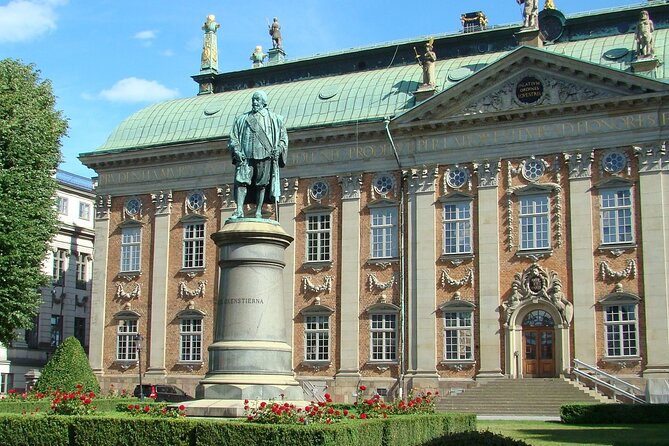
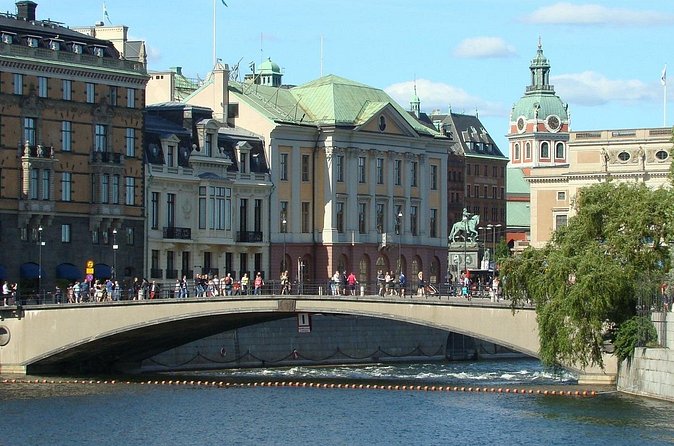
The short walk to Riksbron changes the pace. From the bridge, you can look toward Riddarholmen, often called Knights Island, and see several important buildings gathered around the water.
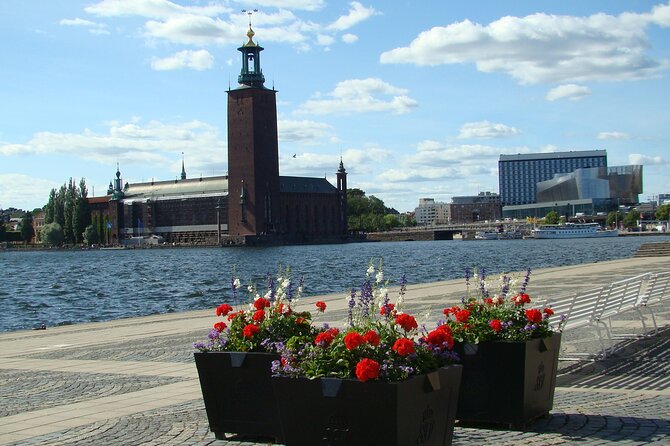
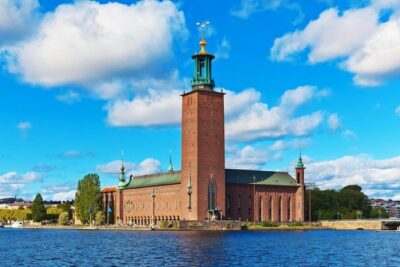
The view includes the prime minister’s residence, government buildings, and the House of Nobility. Stockholm City Hall is also visible. City Hall is the setting for the annual Nobel Prize banquet, so this stop connects Swedish politics, aristocratic institutions, government, and international ceremony in one broad view.
This is one of the tour’s better photo opportunities because the bridge lets you take in several districts at once. It also helps explain Stockholm’s layout. Water is not a backdrop here. It separates and connects the city’s islands, old quarters, government center, and residential areas.
The stop lasts roughly 15 minutes. On a windy day, you may want an extra layer. One review specifically described a very windy outing, so weather can affect how comfortable this open bridge section feels. The view remains worthwhile, but a warm coat or scarf is a practical choice outside the summer months.
Lejonbacken and the Royal Palace’s Northern Face
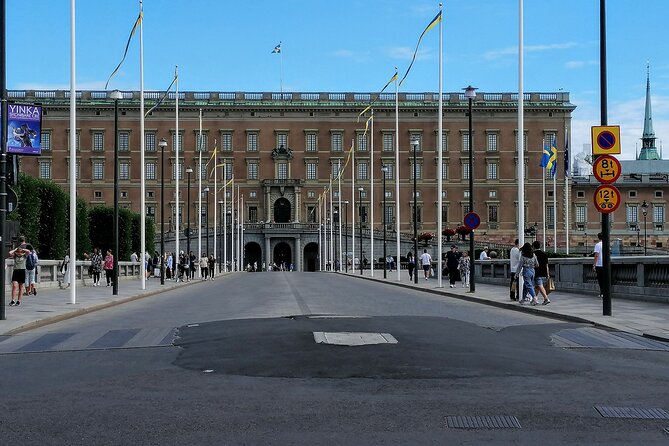
Lejonbacken lies on the north side of the Royal Palace and is one of the most recognizable photo spots in Stockholm. The name refers to the lions that flank the approach. From here, the palace feels especially imposing, and the open space gives you room to appreciate its scale.
The guide places the palace within Sweden’s period as a major Northern European power during the 17th and 18th centuries. You also see the Royal Garden and the statue of Karl XII, remembered as the last of Sweden’s warrior kings.
Look to the right and you can spot Stockholm’s Financial District. Its buildings date mainly from the turn of the 20th century, a period when several architectural styles flourished. The tour does not confine Stockholm to medieval or royal images. It shows you how the city changed as finance, industry, and modern institutions grew.
The Grand Hotel is another notable sight. It is Stockholm’s most prestigious hotel and the place where Nobel laureates stay during the Nobel Prize ceremonies. You will not enter it on this walk, but knowing its role adds a little ceremony to the waterfront view.
A different sort of day, still within reach:
- Stockholm: ABBA The Museum Entrance Ticket
★ 4.7 · 11,280 reviews - Stockholm: City Archipelago Sightseeing Cruise with Guide
★ 4.3 · 10,798 reviews - Stockholm: Skansen Open-Air Museum Admission Ticket
★ 4.5 · 3,427 reviews - Stockholm: Hop-On Hop-Off Bus or Boat Option
★ 4.0 · 3,260 reviews
Slottsbacken, the Palace Chapel, and the Bernadotte Dynasty
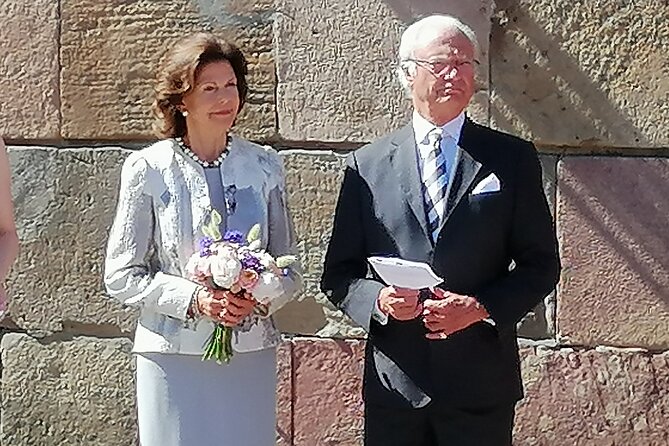
At Slottsbacken, the route passes through the inner courtyard of the Royal Palace and makes a short visit to the Palace Chapel. This is a welcome change from viewing grand buildings only from the street. The chapel is where the royal family baptizes its children, giving the palace a more personal function.
Outside, a statue of Carl XIV Johan opens another unusual chapter in Swedish history. He began as a French military figure in Napoleon’s army before being adopted into the Swedish royal family. He became the first ruler of the Bernadotte dynasty, which still rules Sweden.
His arrival was linked to Sweden’s desire to recover territory lost to Russia during the Napoleonic wars. Yet his approach centered on diplomacy, infrastructure, and education rather than renewed warfare. Sweden celebrated 200 years of peace in 2014, and the walk connects that achievement with later industrial development, natural resources, inventions, and the growth of the welfare state.
This section is valuable because it replaces a simple royal succession story with something more surprising. Sweden’s monarchy includes a French-born founder, and the country’s modern identity was shaped as much by peace and public development as by military power.
Stortorget and the Darkest Chapter in the Old Town
Stortorget is the central square of Gamla stan and probably the most photographed place on the route. Its narrow, colorful buildings show Scandinavian Renaissance and 18th-century Classicism. The square is compact, attractive, and often busy, so the guide’s historical explanation helps you look beyond the postcard view.
In November 1530, the square was the site of the Stockholm Bloodbath. About 100 noblemen and priests were beheaded on the orders of the Danish king Christian II, who became known in Sweden as Christian the Tyrant.
That story changes the mood of Stortorget. The charming facades are not the whole story. The square also represents the violence and power struggles that shaped Scandinavia before modern national borders and political systems settled into place.
The Nobel Prize Museum is located here. The Swedish Royal Academies and other committees select winners in major fields of science and art. Since the museum sits directly on the square, you can connect the old center of royal and religious power with Sweden’s modern international reputation for science, literature, peace, and culture.
You spend around 15 minutes at Stortorget. If you want to visit the Nobel Prize Museum, plan a separate visit, since this walking tour does not include admission.
Köpmangatan and the Medieval Streets of Gamla Stan
From Stortorget, the route follows Köpmangatan, or Merchants Street. Written references to the street go back to 1350, making it one of the oldest named routes in the city.
This is where the walk becomes less about major monuments and more about atmosphere. You move through narrow alleyways that retain the shape of medieval Stockholm, then continue along Österlånggatan toward Skeppsbron.
That change matters. Grand buildings are easy to photograph, but narrow streets help you understand how the old town functioned. The route gives you a short, guided look rather than trying to cover every lane in Gamla stan. For a first visit, that is useful. You get orientation and a few historic anchors, then you can return later to wander at your own speed.
The walk ends near the waterfront, where ships have loaded cargo since the 17th century. Skeppsbron also makes a natural transition from the old merchant city to modern Stockholm’s waterfront districts.
Keep in mind that old streets can be uneven and crowded. The tour asks for moderate physical fitness, and the combination of bridges, courtyards, narrow lanes, and roughly two hours on foot makes supportive shoes a must.
The Finish Near Kungsträdgården and Djurgården
The stated end point is Karl XII’s statue at the southern end of Kungsträdgården. This location is useful for continuing your day. Kungsträdgården is one of Stockholm’s most attractive central parks, and the nearby tram can take you toward Djurgården, the island known for museums.
Djurgården includes the Vasa Museum, Viking Museum, ABBA Museum, and Skansen outdoor museum. The walking tour does not include those attractions, but the ending point makes it practical to add one afterward.
The route itself takes about 1 hour and 45 minutes, though walking pace, questions, and conditions can affect the exact timing. Because the tour ends in a central park rather than at a distant transport stop, you can also continue on foot or make your way back through central Stockholm.
What $106.42 Buys You
At $106.42 per person, this is not a budget orientation walk. You receive no paid admissions, food, or transport. The value depends on how much you want a compact historical framework and the attention that comes with a group capped at 10.
I can see the price making sense for a first-time visitor who wants to understand Stockholm before tackling museums and palace interiors. A strong guide can save you from seeing the Royal Palace, Parliament, Riksbron, and Gamla stan as disconnected photo stops. The stories link them.
The price is harder to justify if you mainly want a casual stroll or already know Stockholm well. You can walk through the Old Town independently, and the tour’s short duration means it cannot explore every building or enter most sights.
The small group improves the offer. On narrow streets, a group of 10 is easier to manage than a large crowd. You should also be able to hear the guide more clearly and ask about details that catch your attention.
Who Will Get the Most From This Walk
I would recommend this experience to first-time visitors, cruise passengers with limited time, couples who want an organized introduction, and anyone interested in Swedish monarchy and government. It also suits people who prefer learning through buildings and streets rather than sitting in a museum.
The route works well for an English-speaking visitor who wants both famous sights and historical context. It is not only a royal tour. You also get the parliament, constitutional reform, medieval commerce, the Stockholm Bloodbath, the Nobel Prize, and the development of modern Sweden.
You may want a different plan if you need extensive interior visits, have limited mobility, or dislike outdoor walking in changeable weather. The bridge and Old Town sections can be windy, and the cobbled or uneven streets require steady footing.
The tour has a perfect rating from three recorded reviews, with particular praise for the friendly guide, clear explanations, and visual aids used to explain architecture. Those visual aids can be especially useful when several buildings share similar styles or when you want to understand how a facade fits into Swedish history.
One review referred to Viking history, but the tour’s focus is actually Stockholm’s Old Town and the city’s development from medieval times onward. Viking-era material may appear briefly for context, but you should book this for Stockholm history, not as a dedicated Viking tour.
Practical Details for a Smooth Morning or Afternoon
The tour is offered in English and uses a mobile ticket. Confirmation is sent at booking, and the meeting point is Gustav Adolfs torg. The route ends at Karl XII’s statue near Kungsträdgården.
Public transportation is nearby at the start and finish. That makes the tour easy to fit into a larger day, especially if you plan to continue to Djurgården after the walk.
The activity is generally booked about 11 days ahead, so I would avoid leaving it until the last minute if your Stockholm dates are fixed. Free cancellation is available when you cancel at least 24 hours before the start time. Cancellations or changes inside that window are not refunded or accepted.
Should You Book the Stockholm Small Group Walking Tour?
Book it if you want a well-paced introduction to Stockholm’s royal center and Gamla stan, and if you value a very small group over the lowest possible price. The strongest parts are the range of subjects, the bridge views, the palace settings, and the move from grand squares into medieval lanes.
Skip it if you want museum admission, a full Royal Palace tour, or a low-cost independent walk. At $106.42, you are paying for interpretation and convenience. For a first day in Stockholm, that can be worthwhile. For repeat visitors, the same money may be better spent inside the Vasa Museum, Nobel Prize Museum, or another attraction.
FAQ
How long is the Stockholm walking tour?
The tour lasts approximately 1 hour and 45 minutes.
Where does the tour begin?
The meeting point is Gustav Adolfs torg, 111 52 Stockholm, Sweden.
Where does the tour end?
The walk ends at the Karl XII Statue near the southern end of Kungsträdgården.
Is the tour offered in English?
Yes. The experience is offered in English.
How many people can join the tour?
The group has a maximum of 10 people.
Can I cancel for a full refund?
Yes, if you cancel at least 24 hours before the experience start time. Cancellations made less than 24 hours before the start are not refunded.
New around Stockholm
- World War II Stockholm Old Town Walking Tour and Army Museum★ 4.6 · 4 reviews
- 3 Hours Guided Shopping Tour in Stockholm Thrifting Stores★ 5.0 · 4 reviews
- Scandinavian Art, Architecture and Design Tour in Stockholm★ 4.5 · 11 reviews
- Wolf and Wildlife Tracking in Sweden★ 5.0 · 9 reviews
- Private Tour: Swedish History Day Trip to World Heritage Candidate Markim-Orkesta from Stockholm★ 5.0 · 8 reviews
- Drottningholm Palace Private Guided Tour★ 4.5 · 15 reviews
- Voyage of the Vikings: Guided Exploration Through Sweden’s Past★ 5.0 · 2 reviews
- Vaxholm Day Trip From Stockholm: Cruise, Fortress, Swedish Fika★ 5.0 · 2 reviews
Walking Tours, compared.
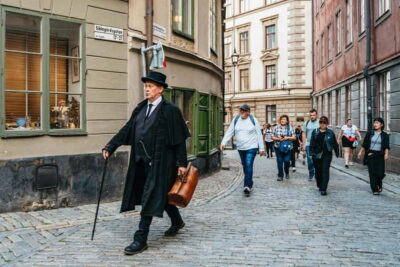
Stockholm Gamla Stan: Old Town Walking Tour with Local Guide
Read our review →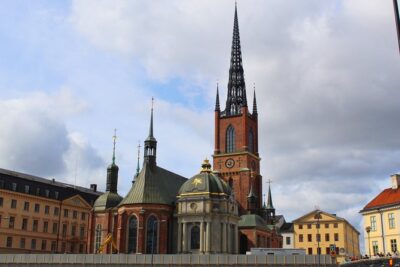
The Original Stockholm Ghost Walk and Historical Tour – Gamla Stan
Read our review →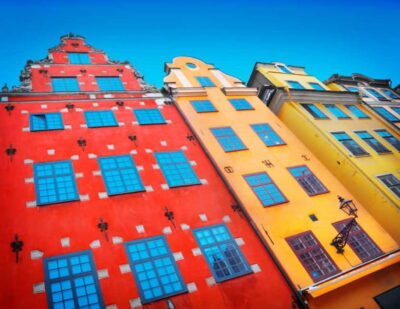
Best of Stockholm Walking Tour-3 Hours, Small Group max 10 people
Read our review →
Browse the lists this tour appears in