

Reviewed · HISTORICAL TOURS
Discover Kiruna: A Walk Through History and Nature
Kiruna keeps its stories above and below ground. I like the way this compact private walk connects LKAB’s mining heritage with the town’s older cultural sites, and I especially like that it ends at Kiruna Church, one of Sweden’s most distinctive wooden buildings. The route gives you a useful first look at a far-northern town shaped by iron, faith, and Sami influence.
The main drawback is the price: $290.89 per person is a serious sum for about two hours, especially since admission is free at each stop. The cost makes more sense for a private group that values a guide’s context and a focused introduction to Kiruna, but it is harder to justify for a solo visitor or couple expecting a full mine tour.
In This Review
- Five things to know before you book
- Why this short Kiruna walk works
- Starting at LKAB’s Visitor Centre
- Meeting the Monument of Ancient Iron Miners
- The Stone Circle and Kiruna’s older stories
- Inside Kiruna Church
- Mining, memory, mystery, and faith
- Is $290.89 a fair price?
- Who will get the most from this experience?
- Practical details that matter
- Should you book this Kiruna walk?
- FAQ
- How long does the Kiruna tour last?
- Where does the tour begin?
- Where does the tour end?
- Is the tour private?
- Are admission tickets included?
- Is the tour available with a mobile ticket?
- Can the booking be canceled or changed?
Five things to know before you book
- LKAB’s Visitor Centre begins the story underground, with exhibits on the technology and work behind Kiruna’s mining industry.
- The Monument of Ancient Iron Miners honors generations of workers, giving the mining story a human focus.
- The Stone Circle adds mystery and age, shifting the walk from modern industry to ancient ritual and local legend.
- Kiruna Church is the visual highlight, with Gothic Revival details, a wooden structure, and an impressive altar.
- This is a private two-hour activity, so only your own group takes part, with group discounts available.
- The route ends at Kiruna Church, not back at the starting point, so plan the rest of your day from Finngatan 1.
Why this short Kiruna walk works
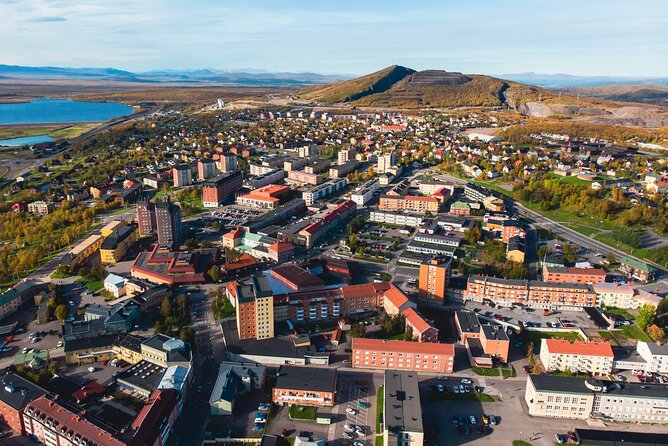
Kiruna can be hard to understand at first glance. It is a modern town in northern Sweden, yet its identity is tied to a mine, old settlements, religious buildings, and the wider northern wilderness. This walk gives you four stops that explain those parts in a sensible order.
I like the progression. You begin with the industrial force that helped create modern Kiruna, then move toward the people who worked in the mine, an older stone site, and finally a church that expresses the town’s cultural character through architecture.
The two-hour length is useful if you are fitting Kiruna into a packed day. You do not need to give up an entire morning or afternoon. At the same time, the short schedule means you should not expect a long mine expedition, a detailed museum visit, or an extended nature outing. This is an introduction, not a full course in Kiruna.
Because the activity is private, you can expect a more personal format than a large public walk. Only your group participates. That matters if you want to ask questions about the mine, the church, or local culture without competing for the guide’s attention.
The route is also close to public transportation, which makes the starting point practical for many visitors. You receive confirmation when booking, and a mobile ticket is available. Still, check both addresses before setting out: you begin at LKAB’s Visitor Centre on Malmvägen 9B and finish at Kiruna Church on Finngatan 1.
More walking tours in Kiruna:
- Stockholm: Ghost Walk and Historical Tour
★ 4.7 · 2,685 reviews - Stockholm Gamla Stan: Old Town Walking Tour with Local Guide
★ 4.7 · 1,714 reviews - Walking Tour of Stockholm Old Town
★ 5.0 · 1,175 reviews
Starting at LKAB’s Visitor Centre
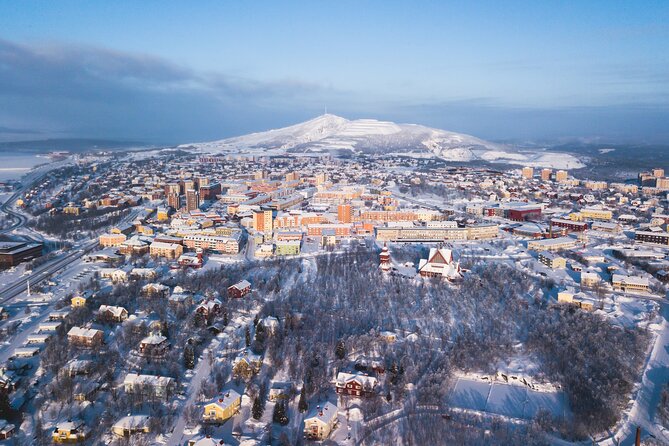
The first stop lasts about 20 minutes, and it gives the walk its basic frame. LKAB’s Visitor Centre focuses on the mining industry’s role in Kiruna’s development, with interactive exhibits about technology, production, and the work needed to operate this major northern industry.
I find this a sensible place to begin because the mine is not just one attraction among many here. It is central to why Kiruna developed where it did and why the town has such a strong industrial identity. Without this introduction, the monument and other sites later in the walk would have less meaning.
The exhibits are described as interactive, so you are not simply looking at static panels. You can expect a presentation built around the machines, methods, and human effort connected with iron mining. That should suit curious adults, families, and anyone who wants more than pretty Arctic scenery.
There is no admission charge at this stop. The guide’s explanation is therefore the main value of the visit. If you already know a great deal about LKAB or mining engineering, 20 minutes may feel brief. If Kiruna is new to you, the timing should help you get your bearings without overwhelming the rest of the walk.
A useful question to ask here is how the mine has affected Kiruna’s growth and character. The supplied details emphasize innovation and dedication, but the stop also gives you a chance to connect the industry with the town you see around you.
Meeting the Monument of Ancient Iron Miners
The second stop is listed as Kiruna Mine and lasts about 40 minutes. Its central feature is the Monument of Ancient Iron Miners, a sculpture honoring the generations of iron miners who worked beneath the ground.
This is where the industrial story becomes more personal. Machines and production figures can explain how mining works, but a monument directs your attention to the people who carried out that work. I like that the walk allows more time here than at the visitor centre. Forty minutes gives the guide room to explain the sculpture and the mining community it represents.
The monument is described as a poignant tribute, and that tone matters. Kiruna’s mining story is not only about economic growth or technical achievement. It also involves demanding labor passed from one generation to the next. The sculpture gives you a physical place to pause and consider that human cost and effort.
Do not confuse this stop with a full underground mine visit. The information provided describes a tribute monument, not an underground tour. If your main goal is to ride into the mine or see working tunnels, you will need to check for a separate activity.
For a first visit, this stop adds depth to the town. You are not merely seeing a mining installation. You are being pointed toward the workers who helped shape Kiruna’s identity.
The Stone Circle and Kiruna’s older stories
The Stone Circle changes the mood. After the modern mine and its workers, you reach an ancient site connected with legends, rituals, and mysterious rites. The visit lasts about 30 minutes.
The details about the Stone Circle are deliberately open-ended. You should expect a site with room for interpretation rather than a fully explained archaeological display. That can be part of its appeal. Standing among old stones, you can think about the people who used the place and the beliefs that may have surrounded it.
I would approach this stop with realistic expectations. The available information does not identify a precise date, explain the circle’s confirmed purpose, or promise archaeological exhibits. The value comes from the setting, the stories attached to it, and the contrast with Kiruna’s modern mining world.
This is also the point where the walk feels least like a conventional city tour. The mine explains the present town. The Stone Circle suggests a much older layer of life in the region. You get a sense that Kiruna cannot be reduced to one industry or one period.
If you enjoy places with legend and uncertainty, you will probably appreciate this part. If you prefer firm historical facts, ask the guide which details are documented and which belong to local lore. That simple question can make the visit more rewarding and keeps the mystery from being presented as certainty.
More history-led tours in Kiruna:
- The Original Stockholm Ghost Walk and Historical Tour – Gamla Stan
★ 4.5 · 1,165 reviews - Stockholm: Guided Historic Old Town Walking Tour with Local
★ 4.8 · 618 reviews - Stockholm: Old Town Historical Walking Tour, small group
★ 4.9 · 411 reviews - Viking History, Runes & Countryside 9h Tour to Sigtuna & Uppsala
★ 4.5 · 283 reviews
Inside Kiruna Church
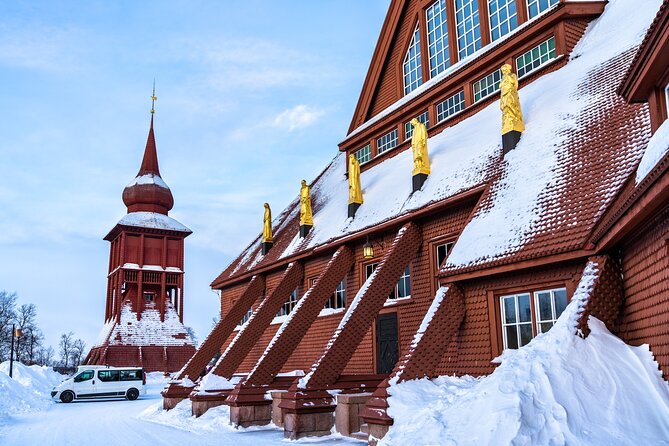
The final stop lasts about 30 minutes, and for many people it will be the most memorable. Kiruna Church is a large wooden building known for its distinctive Gothic Revival design. The tour also highlights its altar, described as a strong blend of religious meaning and artistic detail.
The church offers a calm finish after the mining and stone sites. Its wooden construction gives it a different character from the industrial buildings connected with LKAB. The design reflects a town with a serious religious and cultural life, not just a practical mining function.
A particularly useful detail is that the church is identified as the largest wooden building in Sweden. That is the kind of fact that helps you look closely instead of simply walking in, taking one photograph, and leaving. Study the scale, the structure, and the way the interior frames the altar.
The Gothic Revival label also gives you something specific to notice. Look for the formal, historic style rather than expecting the simple appearance of a small rural chapel. The church is described as serene, so allow yourself a quiet moment inside.
The church is the endpoint at Finngatan 1. That is convenient if you want to continue exploring from there, but it also means you should not assume the guide returns you to Malmvägen 9B. Since the route finishes at a different address, plan your next stop in advance.
Mining, memory, mystery, and faith
The strongest feature of this experience is its range. In two hours, you move through four very different ways of understanding Kiruna.
Industry appears at LKAB’s Visitor Centre, where technology and mining explain the town’s modern development. Human labor comes forward at the monument, reminding you that an industry depends on people, not just machinery. Older beliefs enter at the Stone Circle, where the information is less definite and more connected with legend. Faith and design close the walk at Kiruna Church, a building that gives Kiruna a strong visual identity.
That mix is why the experience can help you understand Kiruna as a city. It does not treat the town as a backdrop for northern scenery alone. Instead, it connects places that might otherwise feel unrelated.
One visitor described seeing Kiruna as a winter wonderland and being surprised by the church’s size and national importance. That reaction makes sense. Snow can make the town look quiet and almost dreamlike, but the walk points out the stories beneath that calm surface.
The route also gives you a better way to read the town after the tour. A mining site will have more meaning. The church will not seem like just another old building. Even the Stone Circle can prompt you to notice how far back local stories may reach.
Is $290.89 a fair price?

At $290.89 per person, this is not a budget walk. Since all four stops list free admission, you are paying mainly for the private format, the guide, organization, and interpretation.
That value depends heavily on how many people are in your group. Group discounts are available, and a private tour becomes easier to justify when the cost is shared. For a larger family group or a few friends traveling together, the personal attention may make sense.
For one person or two people, I would look closely at your priorities. If you want a quick, organized introduction and would otherwise struggle to connect Kiruna’s sites, the price may be worthwhile. If you are comfortable reading signs, visiting the church independently, and learning about the town at your own pace, the cost is harder to defend.
The two-hour duration is both a benefit and a limitation. You are not paying for a whole-day program, and the short format leaves time for another activity. But you also should not expect extensive time at each location or a long nature walk.
The strongest reason to pay is the connection between the sites. The guide turns four stops into one story. The weakest reason is admission, since there are no listed entry fees to offset the price.
Who will get the most from this experience?
I would recommend this walk to several kinds of visitors:
- First-time visitors to Kiruna who want a clear introduction before exploring independently.
- History and industry enthusiasts interested in iron mining and the work behind the town’s growth.
- Architecture fans who want to see Kiruna Church and its Gothic Revival character.
- Families and small groups who value a private format and may benefit from group pricing.
- Visitors with limited time who want a two-hour cultural route near public transportation.
- People curious about local legends, especially those who enjoy sites that leave some questions open.
I would be more cautious if your main aim is an underground mine tour, a long wilderness outing, or a detailed Sami cultural program. The walk touches several themes, but it does not provide an extensive treatment of any one of them.
The available information also does not name the guide. That means you cannot choose a particular guide in advance based on language, personality, or specialist background. You can, however, use the private setting to ask direct questions and shape the conversation around your interests.
Practical details that matter
The activity lasts approximately two hours. Its four scheduled stops total 120 minutes: 20 minutes at the LKAB Visitor Centre, 40 minutes at the mining monument, 30 minutes at the Stone Circle, and 30 minutes at Kiruna Church.
You start at LKAB’s Visitor Centre, Malmvägen 9B, 981 30 Kiruna, and finish at Kiruna Church, Finngatan 1, 981 31 Kiruna. Because the beginning and end are different, keep your mobile map ready and do not arrange your next appointment as if you will return to the starting point.
A mobile ticket is offered, and confirmation arrives at booking. The tour is near public transportation, which helps if you are staying elsewhere in Kiruna. Most people can participate, but the information does not specify a detailed accessibility program, so contact the provider before booking if you have particular mobility needs.
The activity cannot be refunded or changed after booking. That makes it wise to check your date, meeting point, and group size carefully before paying. It is booked, on average, 34 days ahead, so planning early may be sensible during busy periods.
Should you book this Kiruna walk?
Book it if you want a private, compact introduction to Kiruna’s identity and value a guide who can connect mining, memorials, ancient stones, and church architecture. The church and the mining story are the strongest reasons to go, while the Stone Circle adds a welcome note of mystery.
Think twice if $290.89 feels high for a two-hour route with free admission at every stop. You will get the best value by sharing the cost with a group and treating the tour as an orientation to Kiruna, not as a full mine visit or extended wilderness trip.
For first-time visitors with limited time, I see the appeal. The route gives you a useful framework for understanding the town, and you finish beside one of its most striking buildings. For independent explorers on a tight budget, visiting the church and public sites on your own may be the better choice.
FAQ
How long does the Kiruna tour last?
The tour lasts approximately two hours.
Where does the tour begin?
It begins at LKAB’s Visitor Centre, Malmvägen 9B, 981 30 Kiruna, Sweden.
Where does the tour end?
The tour ends at Kiruna Church, Finngatan 1, 981 31 Kiruna, Sweden.
Is the tour private?
Yes. Only your group participates in this private activity.
Are admission tickets included?
Each listed stop has free admission, so there are no separate entry fees shown for the LKAB Visitor Centre, Kiruna Mine monument, Stone Circle, or Kiruna Church.
Is the tour available with a mobile ticket?
Yes. A mobile ticket is available, and booking confirmation is provided at the time of reservation.
Can the booking be canceled or changed?
No. The experience is non-refundable and cannot be changed for any reason after booking.
New around Kiruna
- Half day Wildlife and Nature Photography★ 5.0 · 6 reviews
- Tour to Abisko national park★ 5.0 · 4 reviews
- Snowshoe up a Mountain★ 5.0 · 19 reviews
- Polar Sunrise Eco Experience (10:00-13:00- driving the sled)★ 5.0 · 14 reviews
- Sami day tour adventure★ 5.0 · 22 reviews
- Snowmobile Adventure in Lapland: Guided Tour from Kiruna★ 5.0 · 5 reviews
- Snowmobile Safari to Lapland viewpoint★ 5.0 · 7 reviews
- Northern Light Snowmobile Tour in Kiruna★ 5.0 · 2 reviews
Historical Tours, compared.


The Original Stockholm Ghost Walk and Historical Tour – Gamla Stan
Read our review →
Guided Historic Old Town Walking Tour with Local
Read our review →
Stockholm Viking History Full Day Tour to Sigtuna + Uppsala
Read our review →
Viking History, Runes & Countryside 9h Tour to Sigtuna & Uppsala
Read our review →
Stockholm Archipelago Guided Tour on Historic Ship with Fika
Read our review →
Viking History and Swedish Countryside Tour to Sigtuna & Uppsala
Read our review →Browse the lists this tour appears in