
Reviewed · MUSEUMS
Cube of Art Uppsala Museum of Interactive Art
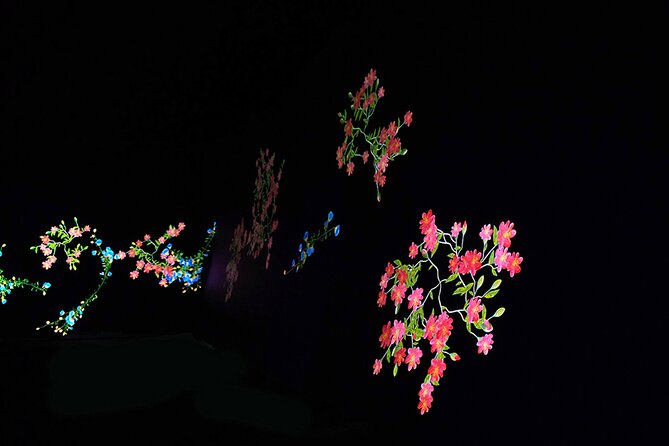
Art that moves when you do. Cube of Art turns a black, seven-meter-high room into a playful digital gallery, using laser and lidar sensors to make colors, shapes, sounds, walls, and floors respond to your movements. I like the hands-on format and the way children and adults can create something together rather than simply look at finished pictures.
I also like the compact one-hour length, which fits neatly into a day in Uppsala. The main drawback is that the experience may feel limited if you expect a large museum with many separate rooms. The space can also feel crowded when more than eight people are inside, and some of the effects may seem less colorful or advanced than you hoped.
In This Review
- Key points at a glance
- What Cube of Art Actually Is
- Entering the Seven-Meter Black Cube
- How Laser and Lidar Make the Art Respond
- Drawing on the Wall and Making Your Mark
- Why Families Often Get the Most From It
- Visiting With Teenagers, Adults, and Work Groups
- What You Can Expect During the One-Hour Visit
- Color, Scale, and the Limits of the Effects
- Is the $21.68 Price Good Value?
- Planning Your Visit in Uppsala
- Who Should Book Cube of Art?
- Should You Book It?
- FAQ
- Where is Cube of Art located?
- How long does the experience last?
- What are the opening hours?
- Is admission included in the ticket price?
- Is hotel transportation provided?
- Can I cancel for a full refund?
Key points at a glance
- A seven-meter black cube: The purpose-built room gives the digital art a strong setting, though it is not a large, traditional museum.
- Laser and lidar technology: Sensors track movement, allowing the art to react to steps, gestures, and touch.
- Drawing becomes part of the show: You can draw on the wall and influence what appears around you, although the image recognition has limits.
- A strong family activity: Children as young as toddlers can take part, while teenagers and adults can enjoy the novelty too.
- About one hour inside: Two rounds may be enough for many people, especially if the room is busy.
- Good rainy-day option in Uppsala: The activity works well when you want something creative, active, and indoors.
What Cube of Art Actually Is

Cube of Art is a museum of interactive digital art in Uppsala, Sweden. Its central feature is a specially designed black cube with a ceiling height of seven meters. Instead of hanging paintings on the walls, the museum projects digital works into the room and uses sensors to make them change as you move.
The technology is the heart of the visit. Laser equipment and lidar sensors detect movement in the space. Your steps, gestures, and touches can affect the shapes, colors, and sounds around you. You are not only looking at the artwork. You become part of what is happening.
That difference matters. At a conventional museum, you are usually asked to keep your distance. Here, the point is to approach, move, draw, and experiment. The experience is designed around play and response, with art meeting science in a very direct way.
I would think of Cube of Art as a short digital art encounter rather than a full museum visit. There are not several large galleries to explore. Instead, you spend roughly an hour in one specially prepared room, watching the environment change as people interact with it.
More museums worth an afternoon in Uppsala:
- Stockholm: ABBA The Museum Entrance Ticket
★ 4.7 · 11,280 reviews - Stockholm: Skansen Open-Air Museum Admission Ticket
★ 4.5 · 3,427 reviews - Stockholm: Paradox Museum Entry Ticket
★ 4.2 · 3,031 reviews
Entering the Seven-Meter Black Cube
The room itself is part of the attraction. Its black surfaces provide a blank backdrop for projected light and animated forms. The seven-meter ceiling gives the images room to spread upward, helping the effects feel larger than a standard screen or wall projection.
You may notice that the name suggests a completely enclosed cube, but the setup does not provide a full roof over the viewing area. That can affect how complete the visual effect feels. If you are hoping for color and moving art on every surface, the room may seem less all-encompassing than expected.
Even so, the dark cube creates a clear break from ordinary museum design. You are not walking past framed objects with small labels. You are entering an active room where the space changes according to the people inside it.
This format is especially easy for children to understand. They do not need a long explanation about digital art before they can participate. A step, wave, or touch produces an immediate response, and that instant cause-and-effect relationship gets people involved quickly.
How Laser and Lidar Make the Art Respond
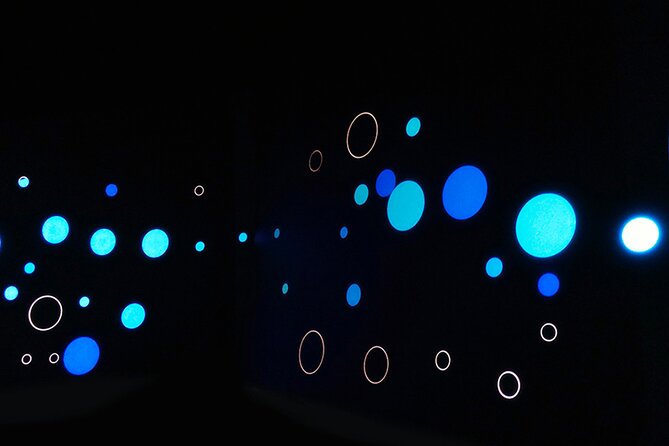
Lidar sensors are used to detect movement and distance. In practical terms, this means the art can react to where you are and how you move through the room. A person walking across the floor may create changes in the projected forms, while a gesture near a wall can influence the display.
You should expect the experience to be intuitive rather than technical. You do not need to learn controls or operate a complicated device. The room provides the response, and you discover the possibilities by moving around.
The effects can include changing shapes, colors, and sounds. The exact result depends partly on how many people are inside and how actively they interact. With only a few people, the experience can feel calm and personal. With a larger group, the art may react to many movements at once, but the room can also feel less comfortable.
This is one reason timing matters. If you prefer space to experiment, a quieter session or a less crowded moment will probably suit you better. If you enjoy shared energy and watching other people trigger the artwork, a busier room may add to the fun.
Drawing on the Wall and Making Your Mark
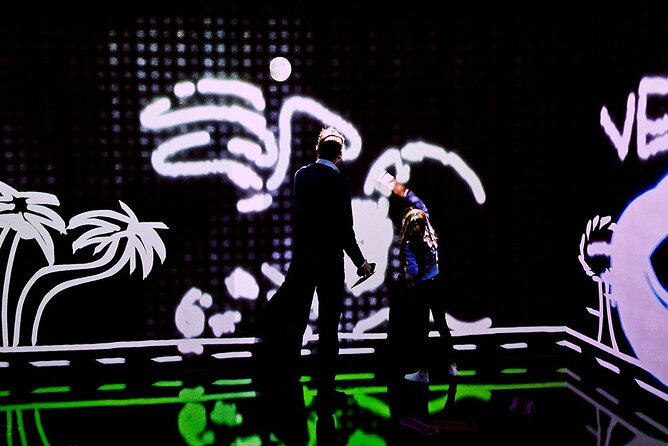
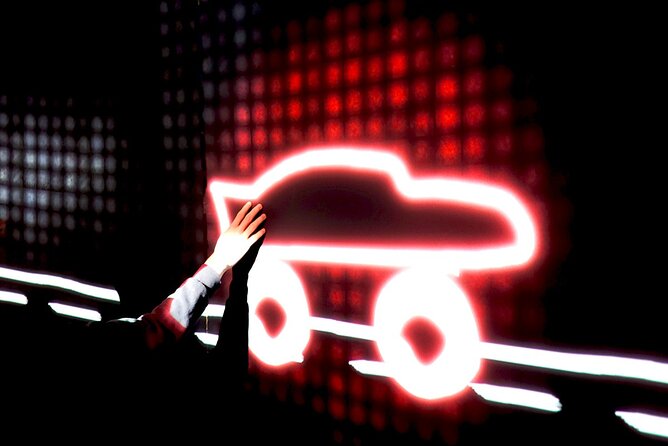
One of the more appealing features is the chance to draw on the wall and influence what appears around you. This gives the visit a creative task, not just a visual one. Children can make marks and then watch the system interpret or animate them.
The recognition is not unlimited. The system appears to work best with certain animals and objects, so you should not expect it to understand every drawing exactly as intended. That limitation is worth knowing before you arrive, especially if an older child expects a highly advanced artificial intelligence art tool.
Still, the basic idea works well. You draw, the system responds, and the wall becomes part of the conversation. I like this because it gives children a reason to slow down and try something rather than simply run from one effect to another.
Adults may enjoy the same feature for a different reason. It shows the boundary between human creativity and machine interpretation. The technology does not always get the drawing right, but that gap can be part of the amusement.
A few more Uppsala options to compare
- Stockholm Viking History Full Day Tour to Sigtuna + Uppsala
★ 4.7 · 283 reviews - Roofwalking on the worlds greatest pink castle!
★ 5.0 · 15 reviews - Uppsala: City Highlights and Hidden Gems Walking Tour
★ 4.7 · 12 reviews - Stockholm: Uppsala Half-Day Swedish Oxford & Cathedral Tour
★ 4.9 · 11 reviews
Why Families Often Get the Most From It

Cube of Art is particularly well suited to families. Very young children can take part because the interaction is based on movement rather than reading. A 10-month-old and a three-year-old can engage with the wall and floor in different ways, while older children can experiment with drawing and cause-and-effect.
A two-year-old may simply enjoy walking through the changing light. A seven-year-old may want to test which movements produce the biggest reaction. Teenagers may appreciate the visual novelty and the chance to take part in something that feels different from a standard museum.
Parents get a useful benefit too: you can play with your children rather than supervise from the edge. The activity gives adults permission to be a little silly, which is often the point of an interactive space.
The one-hour format also works well for families. It is long enough to feel worthwhile but short enough to fit around meals, naps, and other plans in Uppsala. Some people find that two rounds are sufficient. If your children are very engaged, the hour may pass quickly, but you should not assume that the museum offers a full-day activity.
Visiting With Teenagers, Adults, and Work Groups
This is not only a children’s attraction. The technology gives teenagers and adults a reason to visit, especially if you want an activity that is creative without being formal.
With a teenager, the visit can work as a short shared experience rather than a child-centered outing. You can compare how different movements affect the room, try the drawing feature, and discuss whether the technology feels more like art, entertainment, or an experiment.
The museum also suits a small team-building outing. The interactive activities encourage people to participate quickly, and the shared reactions can make conversation easier. It is a useful choice for a group that wants something social but not physically demanding.
Group size affects the mood. When only two to five people are present, the room may feel cozy and manageable. Once the number rises above eight, personal space becomes more limited. You may find yourself waiting for an opening to interact or trying not to interrupt someone else’s experiment.
For adults seeking quiet contemplation, this may not be the right digital art experience. It is active, social, and playful. The value comes from responding to the art, not from standing silently in front of it.
What You Can Expect During the One-Hour Visit
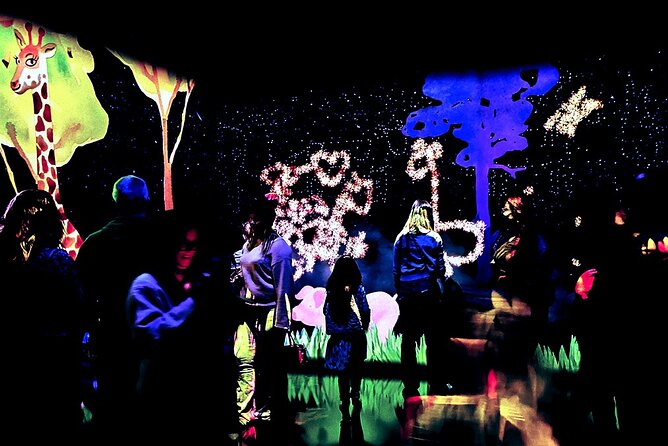
The visit is built around interactive sessions inside the cube. You enter the room and begin testing how the projected art responds. Movement on the floor and interaction with the walls are central parts of the experience.
You might walk through changing forms, wave at projected effects, or draw on the wall. The art may shift in color, shape, or sound as people move. Since the displays respond to the group, your experience will not be exactly the same as someone else’s.
The supplied information does not describe a fixed sequence of named installations, so you should not expect a conventional route with several clearly separated stops. The main attraction is the changing room itself.
A timer helps shape the session, but the exit process may not feel entirely flexible. You may not be able to leave whenever you wish, so keep this in mind if someone in your group needs frequent breaks. This is a small but practical point for families with very young children.
Many people find that an hour feels shorter than expected because there is always another movement to test. At the same time, the limited number of activities means some people may feel ready to leave after one or two rounds.
Color, Scale, and the Limits of the Effects
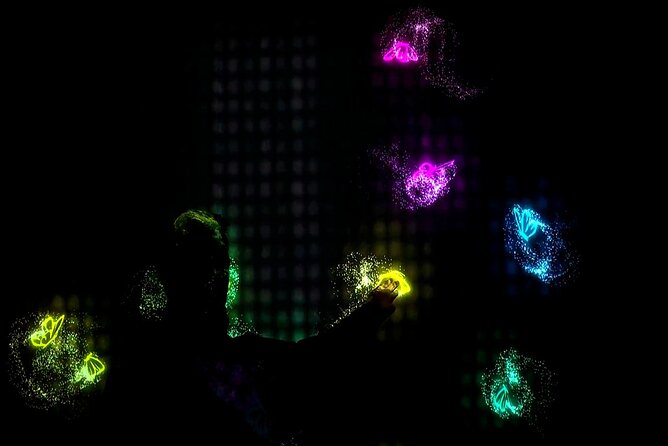
The best moments come from the room responding instantly. When the art follows your movement, the technology feels clear and useful rather than decorative. The scale of the cube also helps the effects spread beyond a small screen.
The visual style may not satisfy everyone. Some people expect a more intense flood of color, with butterflies, circles, and other forms filling the walls in a more chaotic way. If you prefer bold, nonstop spectacle, parts of the visit may seem restrained.
The artificial intelligence element also has boundaries. Wall drawings may be recognized only as certain animals or objects, and the result may not match what you intended. I would treat this as a playful experiment rather than a highly precise art tool.
That expectation makes a difference. If you arrive hoping for a perfect virtual world that recognizes every sketch, you may be disappointed. If you arrive ready to see what the system does with your movement and drawings, the limitations become easier to accept.
Is the $21.68 Price Good Value?
At about $21.68 per person, Cube of Art is not a throwaway stop. For a family, the total cost can add up quickly, so I would consider the visit worthwhile mainly when your group enjoys interactive technology and can make full use of the hour.
The value is strongest for families with children, teenagers looking for something different, and small groups seeking a shared activity. You are paying for access to a purpose-built room, digital artwork, laser and lidar systems, and a structured interactive session. It is not simply a room with a projector.
The value is weaker if you want a large museum with many works, extensive interpretation, or several hours of exploration. There is only one main cube, and some people may feel that there should be more to do.
A current rating of 4.7 from 69 ratings and a 99 percent recommendation suggest that the concept works well for most people who choose it. I would still match the price to your expectations. Pay for a playful digital activity, not for a traditional art museum.
Planning Your Visit in Uppsala
Cube of Art is open Wednesday through Sunday from 10:00 a.m. to 6:00 p.m. during the stated operating period, from December 26, 2024, through February 3, 2027. Check the selected date carefully when booking because the attraction is not listed as open every day.
A mobile ticket is provided, which keeps the arrival process simple. Confirmation is sent at the time of booking, and the museum is near public transportation. Hotel pickup and drop-off are not included, so you will need to make your own way there.
The one-hour duration makes it easy to combine Cube of Art with other time in Uppsala. I would place it on a rainy afternoon or use it as a change of pace after more traditional sightseeing. It can also be a good choice when children need an activity that lets them move.
You can cancel free of charge up to 24 hours before the starting time for a full refund. Changes or cancellations made less than 24 hours ahead are not accepted for a refund. The experience also requires a minimum number of participants, so a cancellation by the provider may lead to another date, another experience, or a full refund.
Who Should Book Cube of Art?
I would recommend Cube of Art if you want:
- A creative indoor activity in Uppsala
- A family experience suitable for very young children
- Something interactive instead of a quiet gallery
- A short visit that fits into a larger sightseeing day
- A team activity that gets people participating quickly
- A playful introduction to digital art and sensor technology
I would think twice if you want a large exhibition, several rooms, detailed art explanations, or a fully enclosed visual world. The space is compact, crowding can affect comfort, and the image recognition is not perfect.
Should You Book It?
Book Cube of Art if you see the appeal of moving through digital art and testing how technology responds. Families with children, teenagers, and small work groups are likely to get the most from the format, especially on a rainy day.
Before booking, set the right expectations. This is a one-hour interactive room, not a major museum complex. If you want playful participation, unusual technology, and shared fun, the $21.68 price can be fair. If you need lots of exhibits or a quiet art experience, spend your time and money elsewhere in Uppsala.
FAQ
Where is Cube of Art located?
Cube of Art is located in Uppsala, Sweden.
How long does the experience last?
The experience lasts approximately one hour.
What are the opening hours?
During the stated operating period, Cube of Art is open Wednesday through Sunday from 10:00 a.m. to 6:00 p.m.
Is admission included in the ticket price?
Yes. Admission is included, along with all fees and taxes.
Is hotel transportation provided?
No. Hotel pickup and drop-off are not included, although the museum is near public transportation.
Can I cancel for a full refund?
Yes. You can cancel at least 24 hours before the local starting time for a full refund. Cancellations or changes made less than 24 hours before the experience are not accepted for a refund.
New around Uppsala
- Uppsala Private Guided Walking Tour★ 5.0 · 3 reviews
- Uppsala: Mountain Bike Rental with Helmet★ 5.0 · 4 reviews
- Uppsala city and Sigtuna city 8h tour from Stockholm★ 4.7 · 3 reviews
- Uppsala Self Guided Sherlock Holmes Murder Mystery Game★ 4.0 · 4 reviews
- Uppsala Must See 2h city walk – 2h tour of all big attractions!★ 5.0 · 4 reviews
- Uppsala Scavenger Hunt and Sights Self Guided Tour★ 5.0 · 2 reviews
- Self Guided Secrets of Uppsala Exploration Game★ 3.5 · 2 reviews
- Stockholm: Uppsala Half-Day Swedish Oxford & Cathedral Tour★ 4.9 · 11 reviews
Museums, compared.




Stockholm Pass: Save up to 50% – Includes Vasa Museum Ticket
Read our review →
Vasa Museum and Vrak Museum of Wrecks Combo Entry
Read our review →


Browse the lists this tour appears in